Grant funding, once the foundation of resilience projects, can no longer be the sole source to advance community risk reduction. Resilience, defined in this context as the ability to withstand and recover quickly from disasters, is a focal point for many communities seeking to close the gap between pre- and post-disaster efforts. Recent changes in the federal funding landscape are shifting funding solutions towards alternatives. We help our clients achieve their resilience goals through alternative funding pathways.
What are the Challenges of Grant-funded Projects?
Grants have helped spur resilience activity, but they are notoriously complex, include various requirements, and often have a high upfront cost, which can become a sunk cost if funds are not secured. While grants will continue to be available at various levels, the shifting landscape creates an opportunity for public, private, and non-profit entities to explore new funding sources.
Our firm has supported more than $4 billion in grants and another $4 billion in public-private partnerships. We are well-versed in helping our clients navigate the labyrinth of grant rules and regulations, including stacking multiple funding streams and administering multiple funding mechanisms for pre- and post-disaster environments.
What Other Funding Sources Exist Beyond Grants?
Several alternative funding options exist beyond federal grants, some of which may be less administratively cumbersome and more streamlined to obtain. Options receiving more attention recently include:
Public-Private Partnerships (PPPs or P3s)
- Government agencies and private-sector companies collaborate to deliver a public project.
- Public and private entities enter a P3 agreement to share the costs, risks, and benefits of completing an infrastructure project.
Taxation- or Fee-based Funds
- Local governments and their constituents agree to fees or taxes to be used to fund specific services, objectives, or activities.
- These funds can come from special assessment or resilience districts, whereby a community (or group of communities) pays a localized fee to fund a project with local benefits.
- For example, stormwater utility enterprise funds are generated through user fees and provide a long-term, consistent funding option for stormwater management projects.
Bonds
- Governments can issue bonds when there are pre-determined outcomes and benchmarks that dictate when and how much of a return on investment a funder will receive. There are several types of bonds that differ in purpose and outcomes, time to maturity, scope requirements, and can incentivize resilience investments.
- Municipal bonds are debt securities issued by local governments to finance a variety of public projects.
- Green and resilience bonds specifically finance environmental or climate-related projects.
- Catastrophe bonds operate like insurance, where the issuer receives payments when a disaster event reaches a predetermined threshold. Issuers are protected against losses from disasters once the threshold is reached. Because these bonds are risky, investors can receive high returns. These bonds are best suited for community-wide protection for events expected to occur once or less per the life of the bond.
Impact Investing and Philanthropy
- Private investors can finance climate adaptation initiatives, such as technology and infrastructure to address energy projects or data innovations to provide climate analytics. Investors seek financial returns from the production of these goods or services as well as indirect benefits to communities. Returns can be based on fixed rates or performance towards a specific goal.
- Philanthropic investments do not require payback but can carry project requirements and performance goals set by the donor group or program.
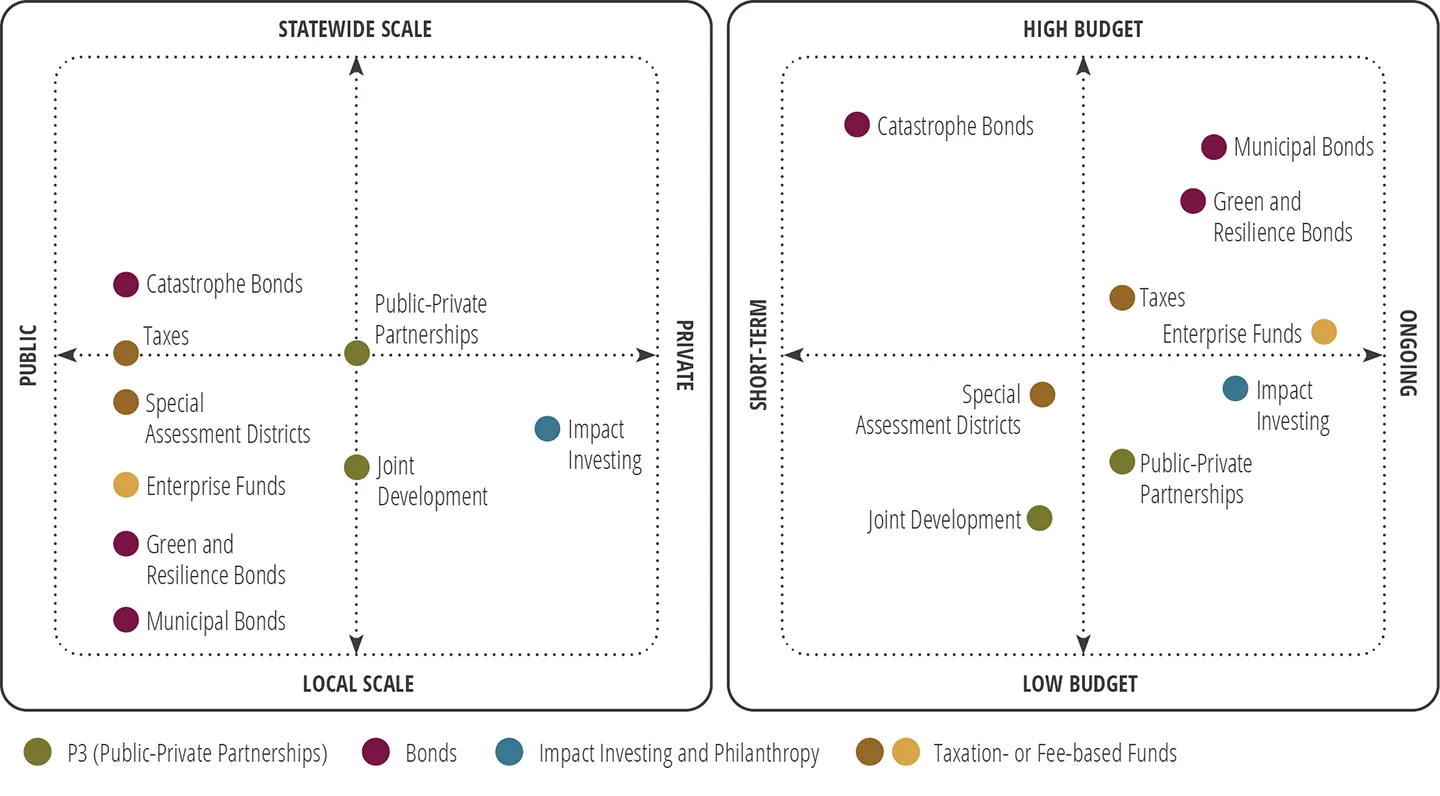
These funding sources can be viewed on a spectrum of “best fit.” Below are two matrices examining entity responsibility by scale of impact and project length by project budget.
Determining the Right Funding Source
Determining the right funding source comes down to several factors for communities to consider:
Project Type
Interested parties must consider the applicability and appropriateness of each funding source. For example, bonds are less applicable to resilience plans and programs and more applicable to infrastructure projects. Funding sources may also have specific timelines, metrics, or outcome requirements.
Project Scale
The size of a project, including geographic scale, required funding, and the number of beneficiaries, often dictates the relevance of a funding source. Some sources are only applicable to certain regions, land uses, or demographics; others have budget maximums or minimums; and some require collaboration with large numbers of stakeholders.
Community Reputation
A community’s bond rating or past project successes can influence which funding source to pursue. Community buy-in is typically necessary.
Timeline
Knowing the required timeframe for a resilience project will help determine the most appropriate funding sources. If a project is deemed urgent, fast delivery of funds may be required, whereas proactive projects may have greater timing flexibility.
Importantly, local entities should review synergistic opportunities and funding source combinations to achieve the needed budget and implementation speed. Local collaboration and goal alignment among agencies, organizations, and the community can affirm that partners are working together to leverage their resources. For example, a greenway project can result in co-benefits for commuters, utilities, and the environment. Meanwhile, collaboration among school districts, transportation departments, and stormwater management departments to implement the project can yield a more comprehensively and efficiently funded project.
How Will Diversifying Funding Strengthen Resilience?
There is increasing demand to bolster disaster resilience—communities are striving to recover faster and be better prepared for extreme events. Whether planning ahead or addressing current resource gaps, communities can maintain critical support and service delivery for their constituents by pursuing innovative and alternative funding pathways.