Often perceived by the public as the epitome of permanence, municipal infrastructure systems are, in fact, subject to a host of changing conditions and evolving influences that can challenge a community’s efforts to maintain the delicate balance of quality of life, environmental protection, and fiscal responsibility.
Perhaps no element better evidences this paradox than combined sewer overflows (CSOs) from combined sanitary sewer/stormwater systems. Once considered a routine measure for preventing backups of untreated wastewater in dwellings and businesses, CSOs have become increasingly problematic to both the built and natural environments as incidences of street flooding and pollutant discharges occur more frequently.
Longstanding approaches to address combined sewer issues have likewise become more complex. For example, the dynamics of changing weather patterns that have contributed to more sudden and intense rainfall events have yet to be fully understood. Costs to design and construct mitigation measures have risen with competition for assistance from government-sponsored grant and loan programs, which are increasingly subject to state and federal budget austerity measures. Even when such assistance is available, communities must still build support for CSO projects among ratepayers, who typically expect solutions to be both effective and economical.
Assessing CSO Intricacies and Influences
While master planning can help define and prioritize interim and long-term CSO needs and abatement measures, the current environment demands that they be more than just a road map for addressing short- and long-term challenges. The plan should reflect a deep, comprehensive understanding of community-specific needs, constraints, and opportunities informed by advanced hydraulic modeling, citizen input, and innovative engineering solutions.
Equally important, the master plan should help make a compelling case to regulators, the public, and funding agencies for a strategy that offers the best path forward, regardless of the challenges and complexities involved, while also offering flexibility to accommodate new issues, influences, and priorities. This includes laying out the fiscally responsible approach to cost-effectively carry out CSO projects, where that funding will come from, and how contributors will benefit.
Of course, no CSO master plan can completely predict the future. But applying a multi-disciplinary approach to the effort will help so that when new questions are asked, the answers will be there."Lou Mammolette and Joe Pavao
Sound, Community-Specific Strategies
Two current projects in Massachusetts illustrate how we have helped communities address CSO needs and strategies through master planning efforts that draw on its extensive expertise across a broad range of disciplines, from environmental and infrastructure engineering and to public involvement and grant writing.
For the City of Chelsea, we developed a citywide Sewer Separation and Flood Mitigation Master Plan, building a detailed combined sewer and stormwater model that was leveraged to develop conceptual-level projects to eliminate or mitigate CSO and flooding concerns. Given Chelsea’s small, roughly two-square-mile area, the approach focused on 100% sewer separation. Refined cost estimates for these interventions coupled with fully-developed needs criteria helped city leaders prioritize projects on a timeframe for execution that was reasonable from a financial capability standpoint. To date, the city has designed and constructed two key projects and begun design of a third project in support of its master plan.
In Somerville, we created a citywide Flood Mitigation and Water Quality Master Plan to align with the city’s existing CSO Long Term Control Plan. Because the city has an extensive combined sewer system, flood mitigation and CSO control are directly related. With the flood mitigation plan, we developed a hydraulic model to understand current and future conditions and provide a critical tool for decision making on future improvement projects. As a result, the city has moved forward with the design of two major projects that we have contributed to.
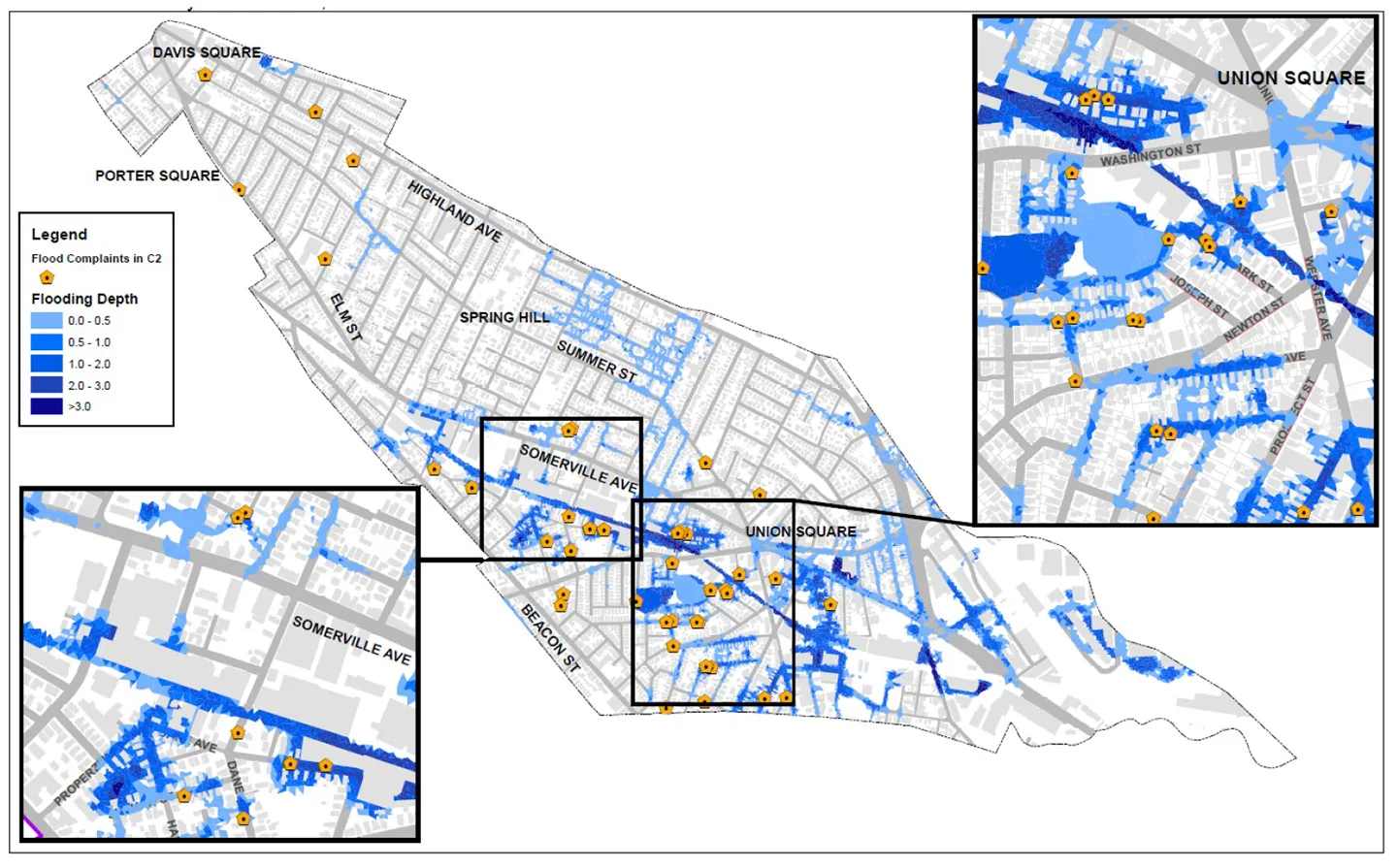 Our team is working on two projects in Massachusetts that address CSO needs and strategies in communities through master planning. Map courtesy of the City of Somerville.
Concurrently, we’re helping the city update its CSO Long Term Control Plan and serve as its representative on regional CSO efforts. High interconnectivity of Somerville’s combined sewer system with nearby Cambridge, and with the Massachusetts Water Resources Authority (MWRA), adds an extra layer of complexity to crafting an updated CSO control plan that reflects the effects of climate change on typical yearly rainfall. Our team is developing a unified hydraulic model that will serve as a crucial tool to evaluate the current and near-future CSO performance of the system and accurately reflect the overall impacts of proposed changes to any of the three systems. There is more work to be done, including consensus building, regulatory collaboration, and financial analyses.
A Foundation for Future Challenges
Of course, no CSO master plan can completely predict the future. But applying a multi-disciplinary approach to the effort will help so that when new questions are asked, the answers will be there.