High-stress and high-pressure situations are a daily occurrence for police personnel, which can take a toll on their physical and mental health. Tasked to serve and protect, it is essential that their work environments support and encourage their overall wellness. Design considerations such as security measures and decompression opportunities can help first responders better support themselves and protect their community.
Police facilities serve a variety of individuals on a daily basis, from law enforcement to civilians. Therefore, wellness within these facilities extends beyond personnel. It encompasses everyone entering the building, including clerks, witnesses, victims, suspects, and the general public. Designing for all occupants’ wellness requires a balanced, holistic approach, with safety as the top priority.
Integrating Security Within a Community
Police facilities serve as a resource to connect law enforcement to the broader community. They provide a space for civilians to report crimes, participate in community programs, and advocate for local change. The built environment can support these functions through thoughtfully designed, welcoming, and secure spaces. By maintaining this equilibrium in design, we create a safe environment for both police personnel and the community. Our team’s conceptual design work for the previously planned Cleveland, Ohio, police headquarters facility is an innovative example of what that balance looks like in practice.
For the conceptual design, we imagined a space that both integrates the community and facilitates efficient operations. A front porch concept would welcome visitors into the building’s community areas, meeting rooms, neighborhood galleries, and informational displays. Beyond aesthetics, the porch and integrated site design would act as a barrier to the facility, prohibiting unauthorized vehicles from entering.
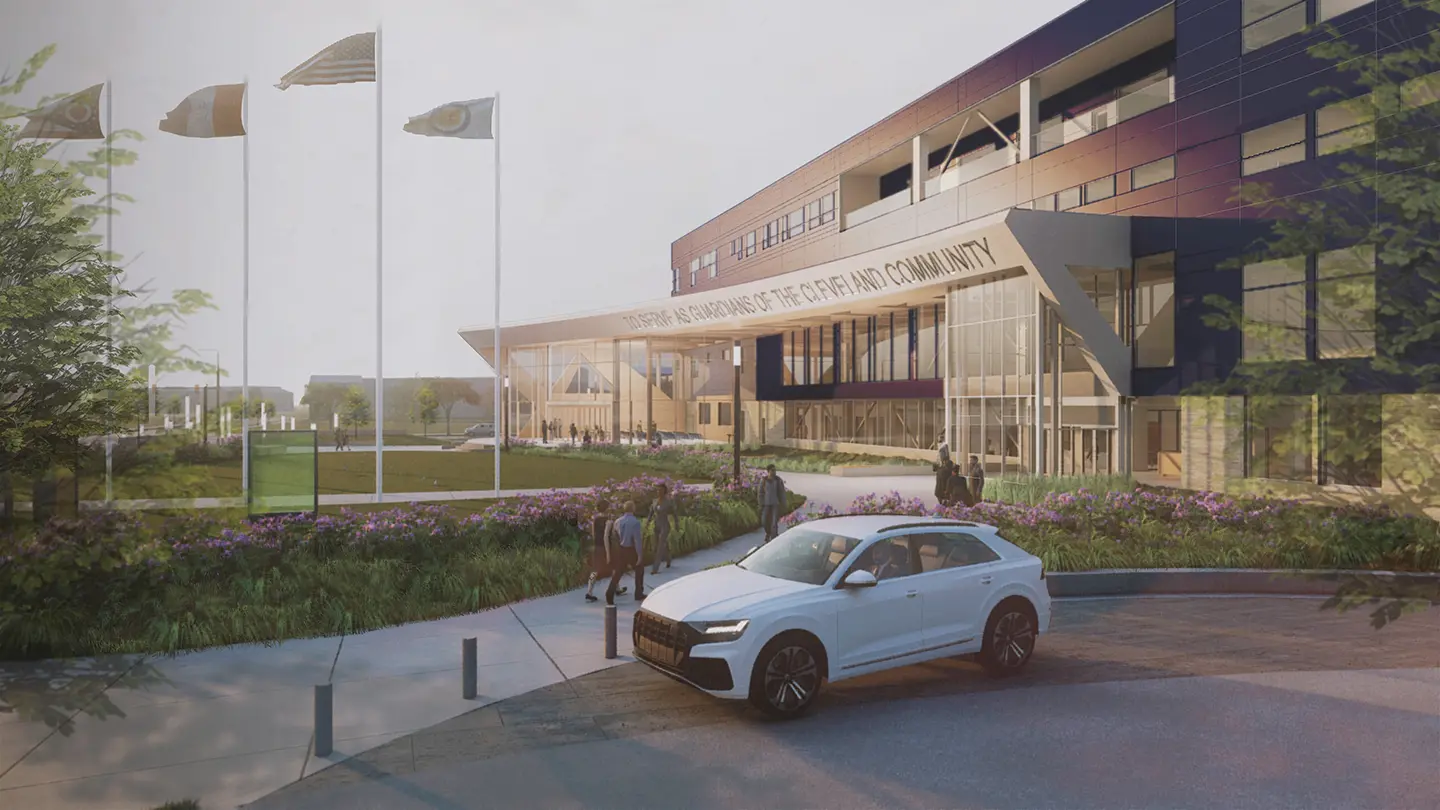 Incorporating elements of Crime Prevention Through Environmental Design (CPTED) allows facilities to both appeal to the broader community and protect the occupants within.
Safety is at the forefront of wellness. Entry, orientation, and circulation considerations are essential to create a distinct separation between public and secure spaces. We can accomplish this separation by designing accessible community spaces on the first level and transitioning to secure police operations on upper levels or by incorporating informed design decisions throughout the facility. Examples of this include entry vestibules, turnstiles, bullet-resistant glazing, unobstructed sightlines, and separate elevators for secure spaces. While these aspects contribute to a facility’s overall security, they are designed to feel welcoming and unobtrusive to the community.
Prioritizing Spaces for Decompression
In addition to security, informed design decisions are instrumental to an officer or facility staff’s decompression before and after duty. Having a variety of recovery areas central to or near the dedicated staff entryway provides convenience and helps to meet diverse wellness needs. While some individuals may prefer to socialize in the break room with colleagues, others may choose to take solace in private areas or find stress relief in an active fitness room.
Dedicated decompression rooms present a quiet, secluded opportunity to step away. In these rooms, we prioritize calming design elements. In Illinois, our team’s work for the Lake in the Hills Police Department features decompression rooms with color-adjustable red, green, and blue (RGB) lighting, enhanced acoustics, individual temperature controls, and comfortable sleeper seating. These rooms are located adjacent to an outdoor wellness patio that encourages access to nature. The dual-use wellness wing allows officers to decompress inside or step outside to a semi-private wellness area for breaks, recuperation, and stress relief.
Break rooms and fitness areas provide a critical opportunity for staff to engage with others and reinforce camaraderie within the police department. These areas are designed to be welcoming, lively, and encouraging of social interaction, which plays a crucial role in reducing stress and providing emotional support.