When you live in an area that is high risk for potentially devastating natural weather events, communication between local officials and residents is critical, and in some cases, can mean the difference between life and death.
A Need for Weather Data
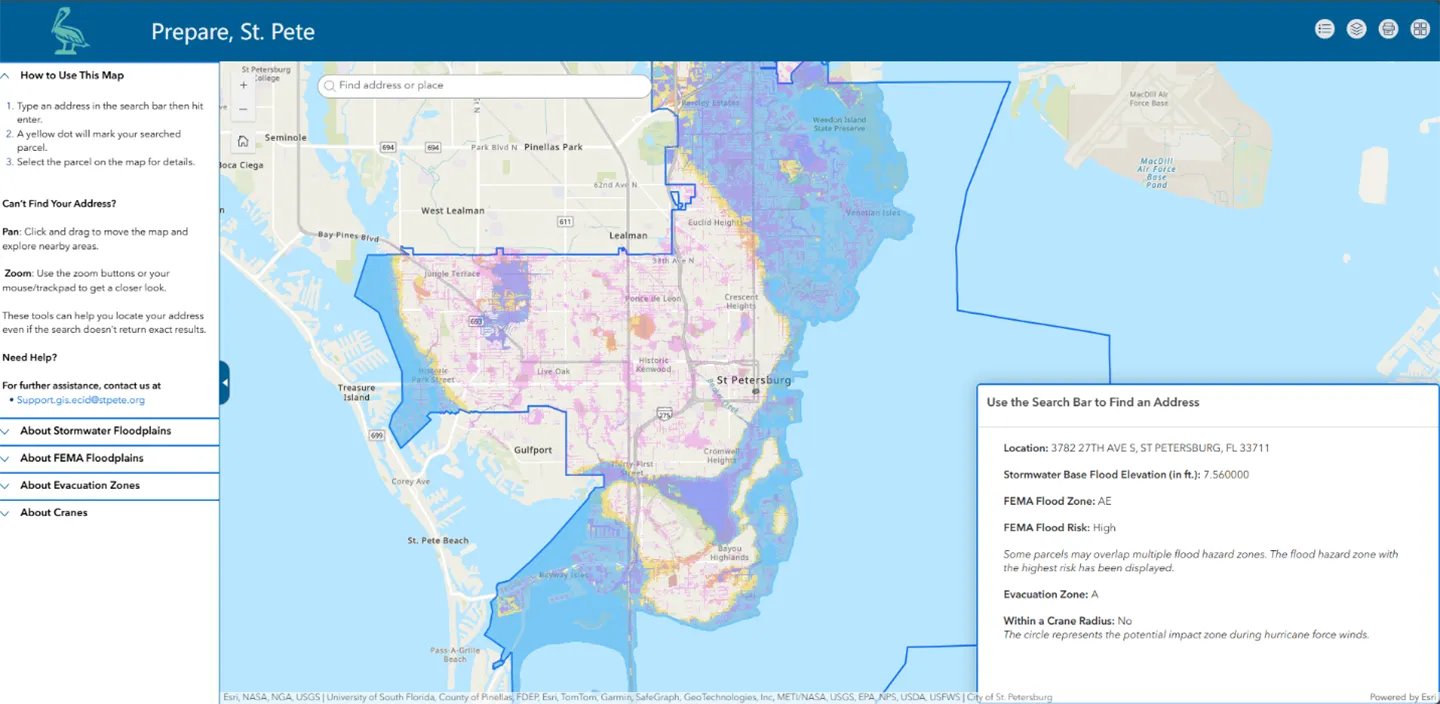
In the wake of the devastation caused by Hurricane Helene, during which residents of the city of Saint Petersburg, Florida, saw storm surges over eight feet and winds of more than 180 mph, the city realized the need for a single, public-facing central place for residents to access accurate and timely data related to the risks its community is facing. To help the city achieve this goal by the 2025 hurricane season, our firm’s geospatial technology services team developed an application called Prepare St. Pete, which is accessible by mobile device or laptop.
Our firm built the application, Prepare St. Pete, using common architecture and datasets synthesized from state, local, and federal sources. The site incorporates an interactive map, where residents can enter their residential or business address to receive updates to help them prepare before, during, and after the event."
Peter Griffin
Designing a Robust Weather Data Application
During application design, we worked closely with city officials to understand the challenges and functionalities needed for the application. Several critical design challenges were identified during discussions:
- Performance and reliability: The highest priority. During a high-usage event, such as a hurricane, the application must reliably perform regardless of the number of users trying to simultaneously access the system, which could easily be in the tens of thousands. To bring this level of desired application performance, we minimized several side requests, limited dynamic calculations, and designed a process focusing on data criticality design and datasets.
- Accessibility: Easy to understand and accessible-friendly presentation of the information was also prioritized. Colors, fonts, and language were all carefully selected and tested to be accessible for the widest range of users, including screen readers and web browser translation. Plain language was emphasized over technical jargon to be approachable by a variety of users.
- Scalability and sustainability: This application was developed, architected, and delivered to the city with the idea that it will change with future needs. Growth in design, datasets, and purpose, driven by community feedback, is built into the core of the application. Datasets can be added and removed easily, and context and supporting information can be updated without the need for any code to be written.
The Final Product
Using a tool called Experience Builder, our team built the application Prepare St. Pete using common architecture and datasets synthesized from state, local, and federal sources. The site incorporates an interactive map, where residents can enter their residential or business address to receive updates to help them prepare before, during, and after the event. They can sign up to receive alerts from city officials, report issues, learn about emergency orders, and gather up-to-date information about evacuation zones, sandbag pick-up locations, and other potential hazards for their property or business. The map is available at www.stpete.org/hurricane.
The Future of the Application
The successful deployment of the Prepare St. Pete application is the initial step to help city residents access powerful data tools to help them make decisions about their safety during a weather event. Future plans include incorporating additional datasets and risk vectors as add-ons to the application and integrating community feedback into future updates. This project served as a valuable tool to foster community resilience through GIS, applications, and data. Ultimately, we are proud to deliver meaningful and digestible information for communities to understand the potential risks of hurricanes and other hazardous weather events.