In a 13-year joint venture, Dewberry was part of team of architects and engineers who provided total facility program management for more than 25 million square feet of the U.S. Department of Labor’s (DOL) Job Corps Program. The program supports more than 60,000 disadvantaged youth with educational and vocational training, and our work implementing their $100 million building construction and rehabilitation program took the team to all 50 states and Puerto Rico.
Encouraging Large-Scale Adoption of Sustainability
The sustainable buildings implementation program we helped develop integrates into the Job Corps’ annual construction and rehabilitation plan. It ensures that new construction and rehabilitation projects comply with sustainable and energy-efficient design standards. In the 13 years we spent putting the plan together, we found that flexibility, responsiveness, and risk-taking were among the most important factors to the successful adoption of such a large-scale sustainability program. Some of the lessons we learned included:
- Make sure your designs are flexible and adaptable. We had to develop solutions for each unique Job Corps campus, like making sure new renewable energy sources shouldered the appropriate amount of energy production, while making sure the solutions fit within the governing agency’s budget. We then moved on to another campus with an entirely new set of needs, like retrofitting a pre-1940s building. We adopted what we could from the earlier solutions to the new situations, but each adaptation required a good amount of flexibility.
- Be responsive. Quick and accurate responses led to strong credibility and a great relationship. We didn’t take days to respond to a question about renewable energy systems, but rather pooled our knowledge and responded within hours. This credibility helped the team balance the needs of the local Job Corps campuses with the DOL’s nationwide resources.
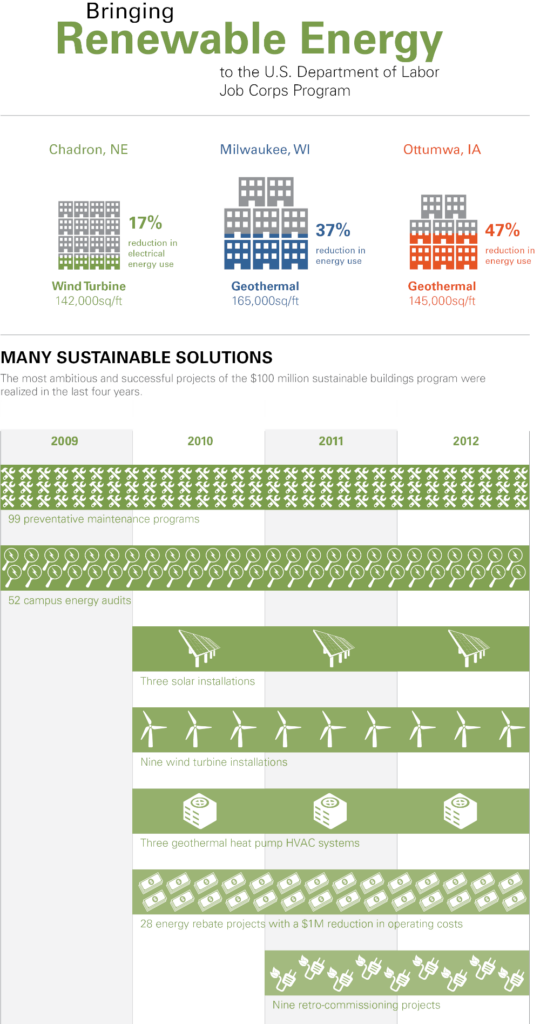
- Be willing to take risks. Risks associated with sustainability are lower now than they used to be, since the return on investment of such technological investments has proven positive over years of study. However, when we implemented sustainable investments across 125 campuses at the onset of the “green” movement, we found the numbers to be a bit off-putting. For example, we implemented a geothermal solution in Ottumwa, Iowa, at a time when most people thought it wasn’t affordable. The project, originally commissioned for environmentally ethical reasons, turned out to be more affordable and significantly cheaper to operate than traditional systems.
There’s More than One Type of Sustainable Design
The infographic below highlights only a portion of the many projects the team completed in service to the Job Corps, but represents the many opportunities to establish and encourage large-scale sustainability programs.
It takes time to realize such significant results, but we’ve brought sustainable buildings and energy-efficient practices to almost every campus in the Job Corps program. Our renewable energy installations, energy audits, retro-commissioning projects, and preventive maintenance programs have brought new life to old buildings, and new buildings to old campuses. To those professionals establishing sustainability programs, remember that it takes more than tenacity to be successful – it takes flexibility, responsiveness, and a willingness to take calculated risks.
About the Authors
Bill Wood