2014 was a fantastic year for our employees and the communities they support through their service. Some of us donned waders and marched through the mud of a watershed while others designed structurally sound works of art from thousands of donated cans of food. In the contributions below, you’ll read about a few ways our employees gave back to their communities in 2014.
Amy Bird: Using 2,300 Cans of Donated Food to Raise Awareness About Hunger in Central Virginia
Dewberry’s Richmond, Virginia, office has been involved in the local Canstruction event for many years. In 2013, we built an octopus (opens in a new tab) out of 1,750 cans of food, 170 cups of applesauce, and three bags of candy. This year, we designed a tribute to the 1980s Nintendo video game, Super Mario Bros. Dubbed, “Super Dewberry Bros (opens in a new tab),” we trucked more than 2,300 cans of donated food to a local mall and used them to build a number of classic items from the video game, including a brick block (opens in a new tab), piranha plant (opens in a new tab), and mushrooms. Topped off by Mario himself (opens in a new tab), every can was donated to central Virginia’s hunger-relief leader, FeedMore, Inc.
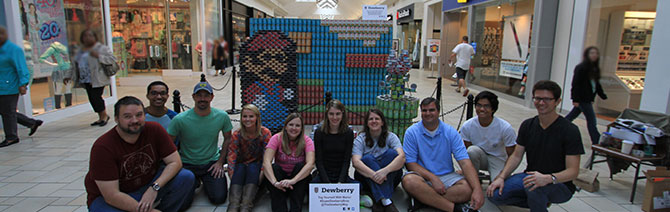
Click here (opens in a new tab) to watch our 2014 Canstruction participation in Richmond, Virginia, and here (opens in a new tab) for our Washington, D.C., participation.
Pam Townsend: Supporting Local STEM Initiatives
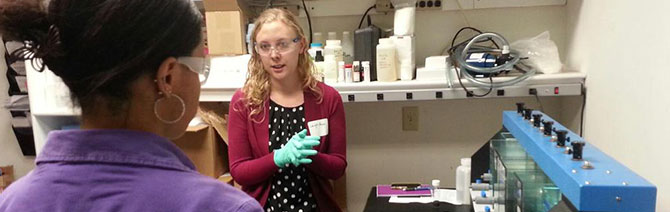
The responsibility of getting underrepresented children, particularly women and minorities, excited to pursue STEM careers falls in part upon the shoulders of our industry’s local businesses. I have a passion for this mission, and that passion really caught on in early November when employees from our Raleigh, North Carolina, office volunteered to host a job shadow day for students from the Wake NC State University STEM Early College High School. We gave students hands-on lessons in our water treatability lab and at our desks using AutoCAD and BIM technologies. Shortly after hosting them, we received wonderful thank you letters from the students, each one biting at the opportunity to intern with us as soon as they’re able.
Joyce Hallinan: ACE Mentor Program of the Greater Metropolitan Washington Area
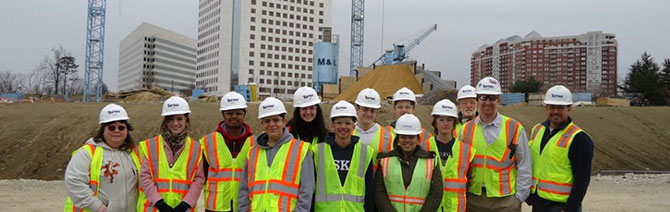
Since 2000, the ACE Mentor Program of the Greater Metropolitan Washington Area (opens in a new tab) has awarded over $400,000 in college scholarships to high school students who create real-life designs of conceptual projects. As an ACE volunteer mentor at George C. Marshall High School in Falls Church, Virginia, I’ve watched students learn how to use 3D modeling software, perform cost estimates, read blueprints, and even survey existing site conditions in order to design fictitious auditoriums, towns, and extensions of the Washington area’s Metrorail. This year was particularly special, as two students from my mentor site received scholarships that will help them learn more about architecture, engineering, or construction in college.
Cheryl Ulrich: Getting Waist Deep in the Anacostia Watershed
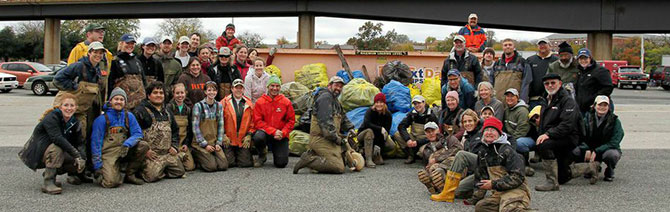
Even as an ecosystem restoration professional, getting my hands dirty isn’t something I have the chance to do very often. As part of Restore America’s Estuaries (opens in a new tab) National Summit on Coastal and Estuarine Restoration, I had the chance to don fishing waders in early November and get waist-deep in the Anacostia Watershed to help more than 70 other volunteers restore tidal wetlands. We primarily restored the wetland’s “goose exclusion fencing,” which helps stem the impact of Resident Canada Geese grazing that leaves bare mudflats in its wake. Installing the fence not only gave the marsh and natural ecosystem a fighting chance, but also allowed me to recognize the impact my work has on communities.
Lindsey and Gary Gardner: Contributing to Discover Engineering Family Day at the National Building Museum
What’s a child to do on a cold and slushy February weekend? This past year, children in Washington, D.C., braved the snow for a day of engineering discovery capped off by learning how to build a catapult. Using miniature pop-fly catapults, we demonstrated basic engineering principles and gave children the opportunity to lay siege to a cardboard castle. As part of Discover Engineering Family Day (opens in a new tab) hosted annually at the National Building Museum, we guided children through the process of making the catapults and explained the basic principles of how they work. This event exposed children of all ages to the possibilities of engineering… and medieval conquest.
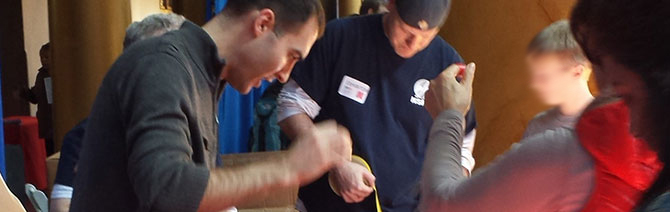
Krista Sullivan: Opening Doors at VDOT’s 10th Annual High School Career Fair
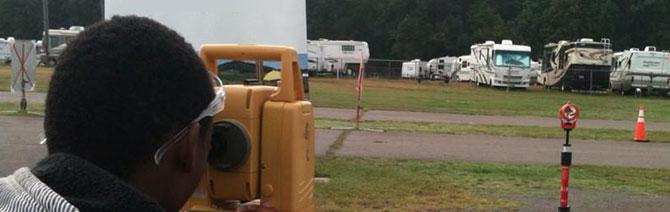
High school is full of young adults trying to figure out what they want to do with the rest of their life. While some of them are lucky enough to find direction in the classroom or from a book, others can only find their passion by experience. The Virginia Department of Transportation’s Annual High School Career Fair creates that type of opportunity. In early October, we spoke with nearly 1,000 students about job opportunities (opens in a new tab) out of high school while testing their natural skills at surveying and bridge building (opens in a new tab).
From all of us at Dewberry, we wish you, your families, and all those in your communities a safe and happy holiday season.
About the Authors
Amy Bird
Pam Townsend
Joyce Hallinan
Cheryl Ulrich
Lindsey Gardner
Gary Gardner