Last week’s blog, “Look Before You Leap: Pursuing Design-Build,” addressed a number of significant issues to consider when assembling a design-build team. These issues – cultural and strategic alignment, availability of key talent, and a relationship that works at all levels of management – are instrumental in forming an effective design-build partnership. A reasonable and fair allocation of risk is also critical. The following are a few additional considerations that speak to the most important attribute of a design-build team: trust.
Value the Client Equally
Client value is an important ingredient in the partnership formula. Design-build relationships are more likely to succeed when both the design firm and the contractor place a high value on the client and ensuring their satisfaction in the project outcome. The partnership can be a risky proposition if one design-build partner is less invested in the long-term client relationship than the other. A clear understanding and commitment on this point can have a significant impact on the success of the team.
Is This the Right Project?
Confidence that you’ve formed a strong design-build partnership – with a solid commitment to the client and the design-build approach, along with open communications and a talented team – is still only part of the equation. It is also vitally important to be discriminating in terms of the specific project pursuit. Is the project a good fit for our team in terms of experience? Do we fully understand the selection criteria and do our team’s strengths align? Do we see our team being able to deliver a “best value” proposal (qualifications, technical approach, innovation solutions, and a competitive price)? Are the schedule and client budget realistic? And importantly, what is the cost to pursue the project – relative to the probability of winning and the project risk?
Evaluate the Opportunities
As Dewberry has undertaken more and more design-build projects over the years, including large-scale civil and transportation initiatives, we’ve learned to look carefully at the inherent opportunities presented in the procurement and proposed design-build project. Is the client willing to let us bring our team’s ideas to the table to make the project more successful? Or has the project been thoroughly scripted by the client, with little room for innovation? If so, the rewards of the design-build process, including options for saving time and money through inventive solutions, may be limited. In our experience, the most successful design-build projects – for the designer, contractor, and owner – are those for which our team can bring creative and innovative solutions to save time and money that get us in the winner’s circle.
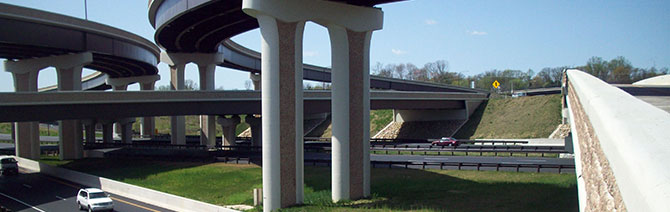
Our recent and current work with the Maryland State Highway Administration (SHA) to design and build part of the 19-mile Intercounty Connector (ICC) exemplifies the successful application of creativity in design-build delivery. Contract C, at the time the largest design-build contract in Dewberry’s history, is one example. Completed in 2012, this project included nearly four miles of six-lane roadway along with two three-level interchanges, 20 new bridges, ten retaining walls, nine major culvert crossings, and much more.
The Intercounty Connector is a major initiative for SHA, and the agency’s knowledgeable and dedicated team demonstrated a willingness to consider creative alternatives to the proposed designs under Contract C. This enabled our team, led by Shirley Contracting Company and Clark Construction Group, to redesign two interchanges during the RFP process, saving time and money for the client. We also proposed the extensive use of wick drain technology to stabilize areas with unsuitable soil, allowing for conventional fill embankment construction in place of more costly bridge structures; and eliminated the need to relocate existing high voltage transmission towers, once again providing significant time and money savings to the project.
Over the years, we’ve completed several projects with the Shirley Contracting team, beginning with the PPP Route 28 Corridor Improvements in Northern Virginia. This relationship has become a model for us as we enter into design-build arrangements in other markets and service areas. A trusted relationship, one that values the client and engenders collaboration and creativity, is at the heart of successful design-build.